Qubit Dynamics

An introduction to two-level system dynamics, the Bloch sphere, and driving fields with rotating wave approximation.

PUBLISHED: Nov 12, 2024

Visualization code for this post: github.com/dvdawg/qnl-prep

Note: throughout this post, we often omit a factor of \hbar in Hamiltonians. This is done to work with frequencies rather than energies — recall that the units of \hbar are Js\text{J}\cdot\text{s}.

Two-Level System

Finding the time-dependent wavefunction

For Hamiltonian H^=ωσ^z\hat{H} = \omega\hat{\sigma}_z, we use the time evolution unitary U^=eiH^t/\hat{U} = e^{-i\hat{H}t/\hbar} to transform our initial state ψ=α0+β1\ket{\psi} = \alpha\ket{0}+\beta\ket{1}. Recall that the unitary transformation of any generator operator G^\hat{G} is

U^=eiG^t/\hat{U}=e^{-i\hat{G}t/\hbar}

Using the Hamiltonian in this expression creates a phase for both 0\ket{0} and 1\ket{1}, introducing time evolution as the transformation to our wavefunction. We evaluate the behavior of the Hamiltonian when applied to the basis:

H^0=ω0        eiH^t/=eiωt/\hat{H}\ket{0} = \omega\ket{0} \;\implies\; e^{-i\hat{H}t/\hbar}=e^{-i\omega t/\hbar} H^1=ω1        eiH^t/=eiωt/\hat{H}\ket{1} = -\omega\ket{1}\;\implies\; e^{-i\hat{H}t/\hbar}=e^{i\omega t/\hbar}

and thus gives the following expression when inserted into our original state:

ψ(t)=αeiωt/0+βeiωt/1\ket{\psi(t)} = \alpha e^{-i\omega t/\hbar}\ket{0} + \beta e^{i\omega t/\hbar}\ket{1}

The Bloch Sphere

We can prove any generic state ψ\ket{\psi}, up to a global phase, is mappable to a point on the surface of a sphere. Starting from ψ=αeiω1t/0+βeiω2t/1\ket{\psi} = \alpha e^{i\omega_1 t/\hbar}\ket{0} + \beta e^{i\omega_2 t/\hbar}\ket{1}, since only the relative phase has physical meaning, we rewrite as

ψ=α0+βei(ω2ω1)t/1\ket{\psi}=\alpha\ket{0} + \beta e^{i(\omega_2-\omega_1)t/\hbar}\ket{1}

Using α2+β2=1\alpha^2+\beta^2=1, we reparameterize into the form

ψ(t)=cosθ20+sinθ2eiϕ1,θ[0,π], ϕ[0,2π)\ket{\psi(t)} = \cos\frac{\theta}{2}\ket{0} + \sin\frac{\theta}{2}e^{i\phi}\ket{1}, \quad \theta \in[0, \pi], \ \phi\in[0, 2\pi)

With this parameterization, we can use θ,ϕ\theta, \phi as spherical coordinates with radius 1 to define points on the unit sphere. In Cartesian coordinates:

r=sinθcosϕ x^ +sinθsinϕ y^ +cosθ z^\vec{r}=\sin\theta\cos\phi\ \hat{x}\ + \sin\theta\sin\phi\ \hat{y}\ + \cos\theta\ \hat{z}

Defining α=αeiω1t/\alpha'=\alpha e^{i\omega_1 t/\hbar} and β=βeiω1t/\beta'=\beta e^{i\omega_1 t/\hbar}, we can re-express the Cartesian vector as:

r=2Re(αβ) x^+2Im(αβ) y^+(α2β2)z^\vec{r} = 2\operatorname{Re}(\alpha'^*\beta')\ \hat{x}+2\operatorname{Im}(\alpha'^*\beta')\ \hat{y}+(\alpha'^2-\beta'^2)\hat{z}

Alternative representation via density matrix. The density matrix of this pure state is

ρ=12(1+cosθeiϕsinθeiϕsinθ1+sinθ)=(α2αβαββ2)\rho=\frac{1}{2}\begin{pmatrix}1+\cos\theta& e^{-i\phi}\sin\theta \\ e^{-i\phi}\sin\theta & 1+\sin\theta\end{pmatrix}=\begin{pmatrix}|\alpha'|^2 & \alpha'\beta'^*\\\alpha'^*\beta' &|\beta'|^2\end{pmatrix}

The x,y,zx, y, z coordinates correspond to expectation values of the Pauli matrices,

x=ψσ^xψ,y=ψσ^yψ,z=ψσ^zψx = \bra{\psi}\hat{\sigma}_x\ket{\psi}, \quad y=\bra{\psi}\hat{\sigma}_y\ket{\psi}, \quad z=\bra{\psi}\hat{\sigma}_z\ket{\psi}

which follows from ψσ^iψ=Tr(ρσi)\bra{\psi}\hat{\sigma}_i\ket{\psi}=\mathrm{Tr}(\rho\sigma_i):

ψσ^iψ=Tr (ρσi)=12(x Tr (σxσi)+y Tr (σyσi)+z Tr (σzσi))=ri\bra{\psi}\hat{\sigma}_i\ket{\psi}=\mathrm{Tr}\ (\rho\sigma_i)=\frac{1}{2}\left(x\ \mathrm{Tr}\ (\sigma_x\sigma_i)+y\ \mathrm{Tr}\ (\sigma_y\sigma_i)+z\ \mathrm{Tr}\ (\sigma_z\sigma_i)\right)=r_i

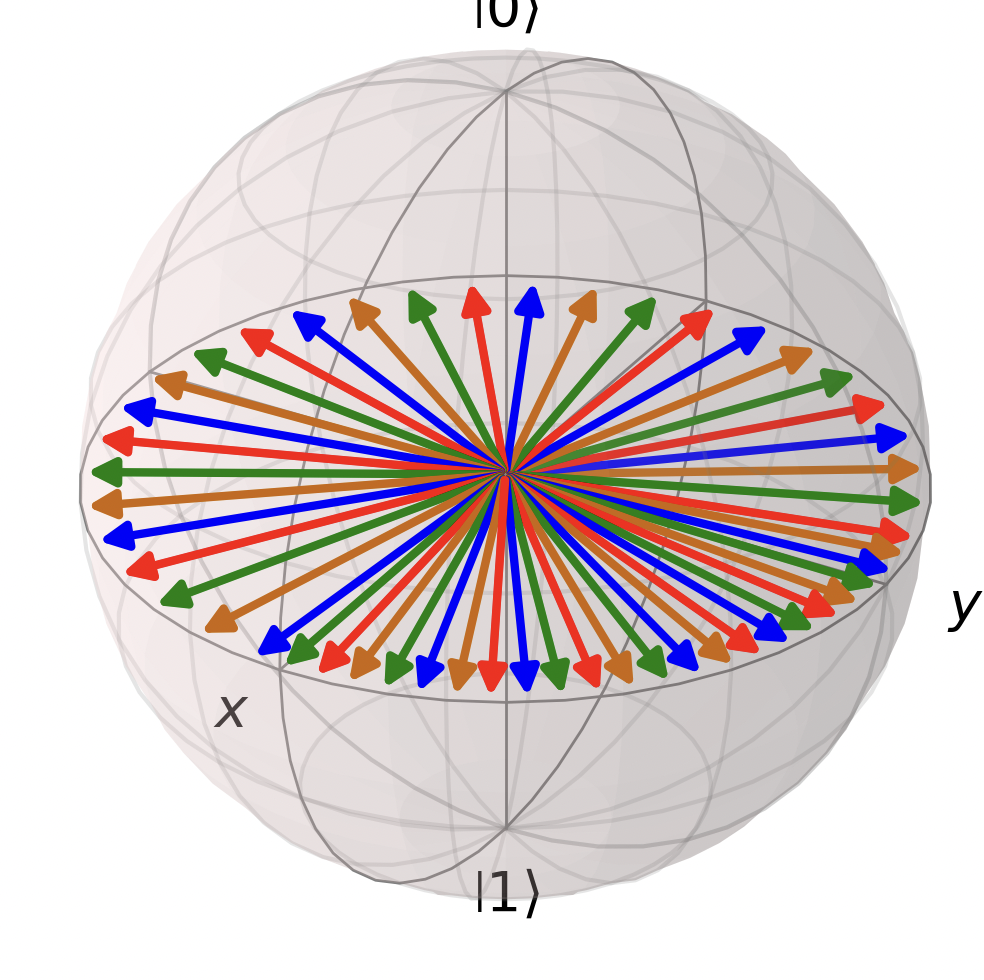
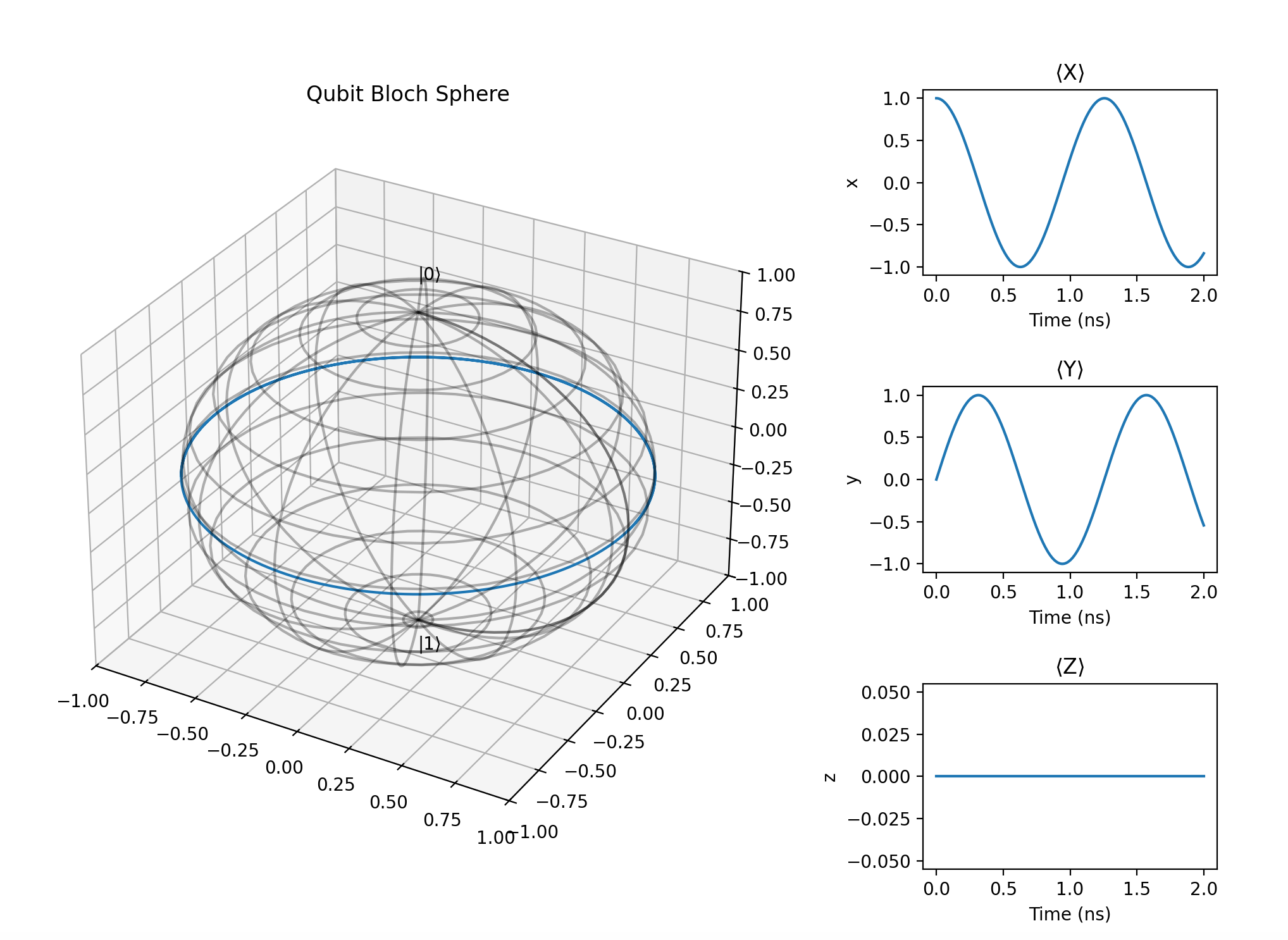
Bloch sphere visualizations with initial conditions α=12,β=12\alpha=\frac{1}{\sqrt{2}}, \beta=\frac{1}{\sqrt{2}}, created with qutip and matplotlib:

Bloch sphere qutip Bloch sphere matplotlib

Driving Field

Mathematical Derivation with Rotating-Wave Approximation

We now consider the Hamiltonian H^=ωqσ^z2+Acos(ωdt+ϕ)σ^x\hat{H} = \frac{\omega_q\hat{\sigma}_z}{2} + A\cos(\omega_d t + \phi) \hat{\sigma}_x, focusing first on the resonant case ωq=ωd\omega_q=\omega_d.

We shift into the rotating frame via a unitary transformation

H^H˘=U^H^U^+iU˙U^\hat{H}\longrightarrow\breve{H} = \hat{U}\hat{H}\hat{U}^\dag + i\hbar\dot{U}\hat{U}^\dagger

Defining Ω=Aeiϕ\Omega=Ae^{i\phi}, the driving term becomes

Acos(ωdt+ϕ)=12Ωeiωdt+12ΩeiωdtA\cos(\omega_d t + \phi)=\frac{1}{2}\Omega e^{i\omega_dt}+\frac{1}{2}\Omega^* e^{-i\omega_dt}

We choose the rotation unitary based on the free Hamiltonian,

U^=eiωdt2σ^z=eiωdt/200+eiωdt/211\hat{U} = e^{\frac{i\omega_dt}{2}\hat{\sigma}_z}=e^{-i\omega_dt/2}\ket{0}\bra{0}+e^{i\omega_dt/2}\ket{1}\bra{1}

Using the raising and lowering operators σ^+=01\hat{\sigma}_+=\ket{0}\bra{1}, σ^=10\hat{\sigma}_-=\ket{1}\bra{0} and the substitution σ^x=σ^++σ^\hat{\sigma}_x=\hat{\sigma}_++\hat{\sigma}_-, we find

eiωdt2σ^zσ^xeiωdt2σ^z=eiωdtσ^++eiωdtσ^e^{\frac{i\omega_dt}{2}\hat{\sigma}_z}\hat{\sigma}_xe^{-\frac{i\omega_dt}{2}\hat{\sigma}_z}=e^{i\omega_dt}\hat{\sigma}_+ +e^{-i\omega_dt}\hat{\sigma}_-

Expanding, setting ωq=ωd\omega_q=\omega_d, and applying the rotating wave approximation (dropping terms oscillating at 2ωd2\omega_d):

U^H^U^=ωqσ^z2+12(Ωσ^++Ωσ^)\hat{U}\hat{H}\hat{U}^\dag=\frac{\omega_q\hat{\sigma}_z}{2}+\frac{1}{2}(\Omega\hat{\sigma}_++\Omega^*\hat{\sigma}_-)

The second term of the transformation evaluates to

iU˙U^=ωdσ^z2i\hbar\dot{U}\hat{U}^\dagger=-\hbar\frac{\omega_d\hat{\sigma}_z}{2}

Putting both terms together and canceling the σ^z\hat{\sigma}_z terms with ωq=ωd\omega_q=\omega_d:

H˘=12(Ωσ^++Ωσ^)=12(0ΩΩ0)\breve{H}=\frac{1}{2}(\Omega\hat{\sigma}_++\Omega^*\hat{\sigma}_-)=\frac{1}{2}\begin{pmatrix}0 & \Omega \\ \Omega^* & 0\end{pmatrix}

Visualization and Analysis

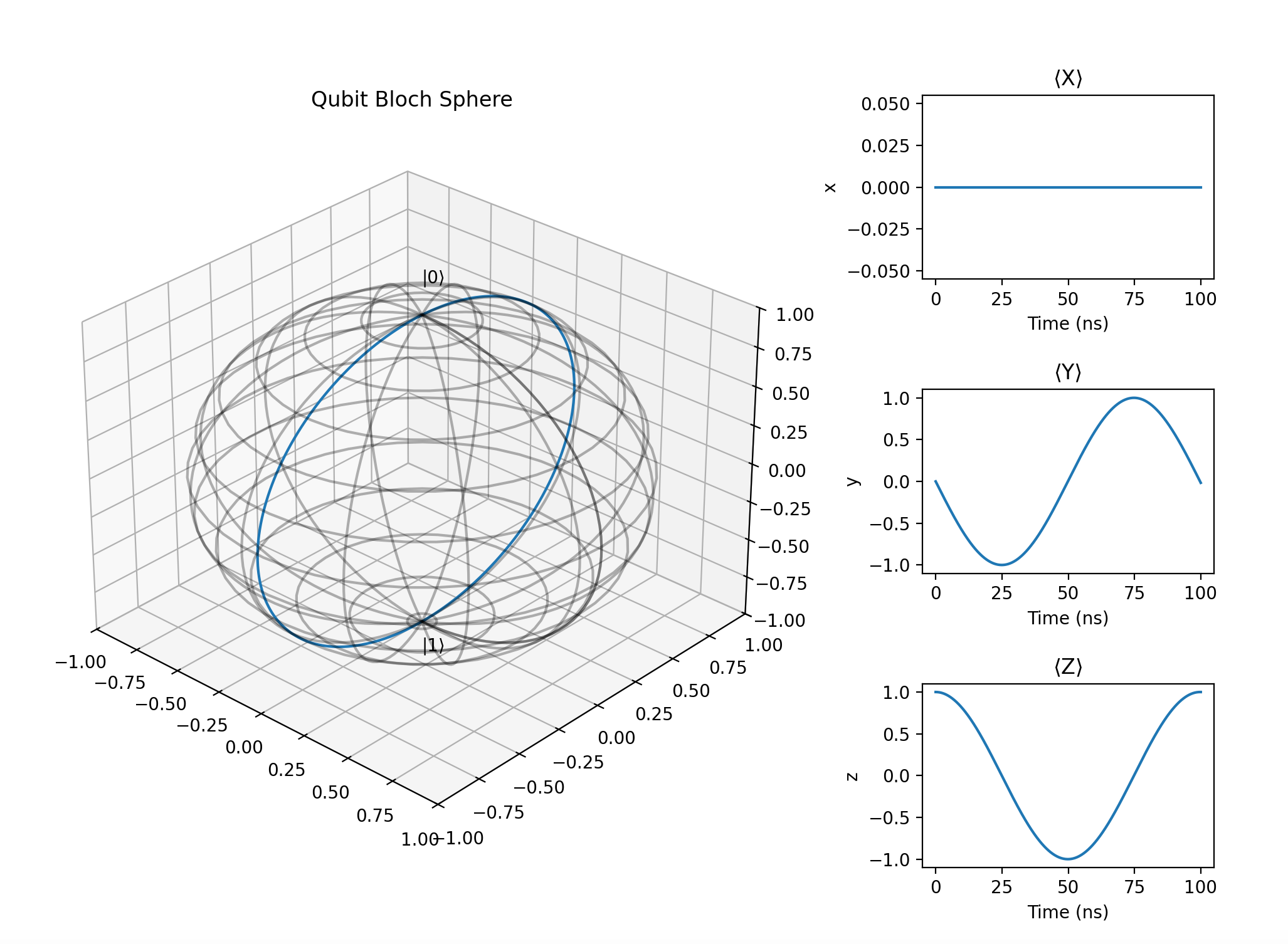
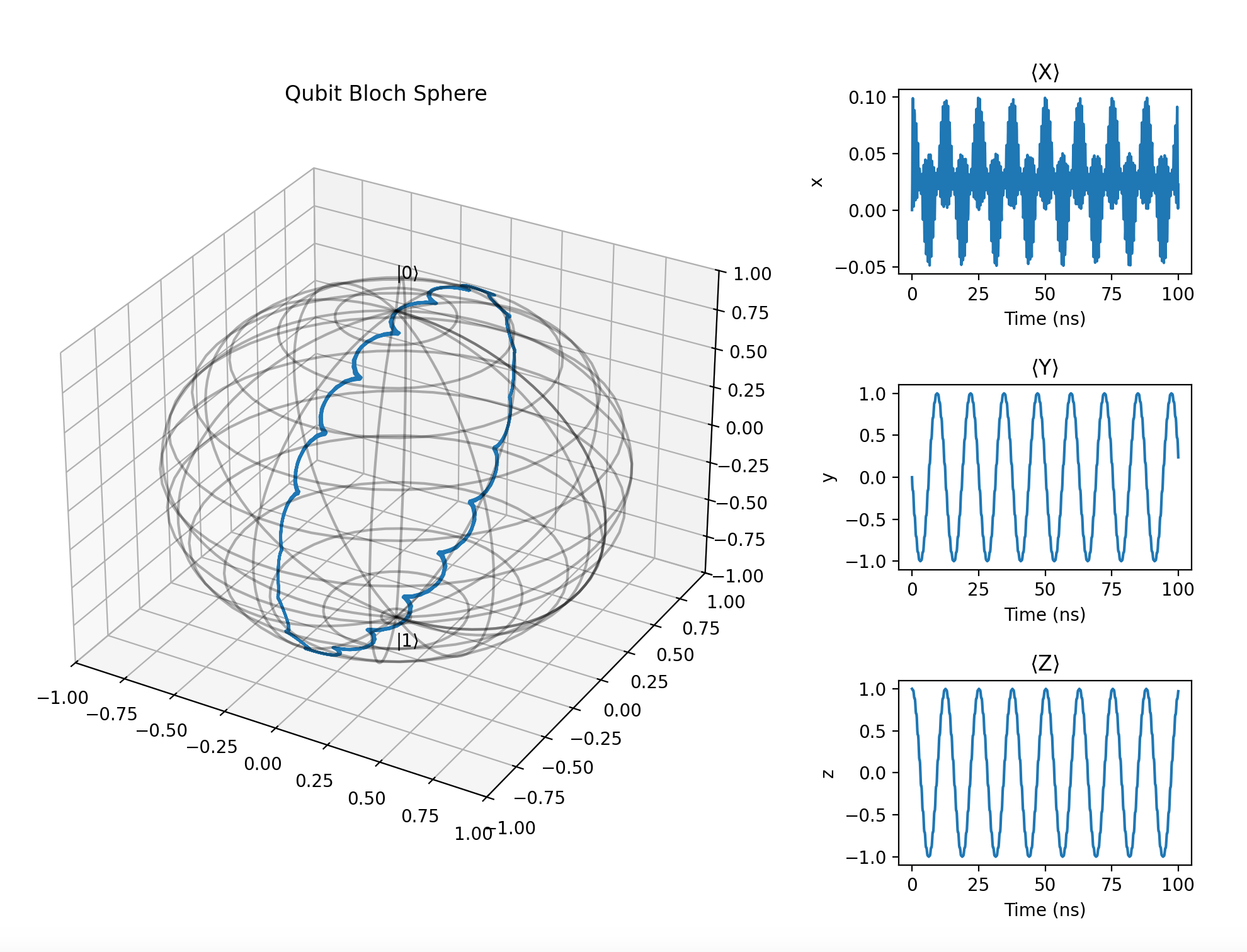
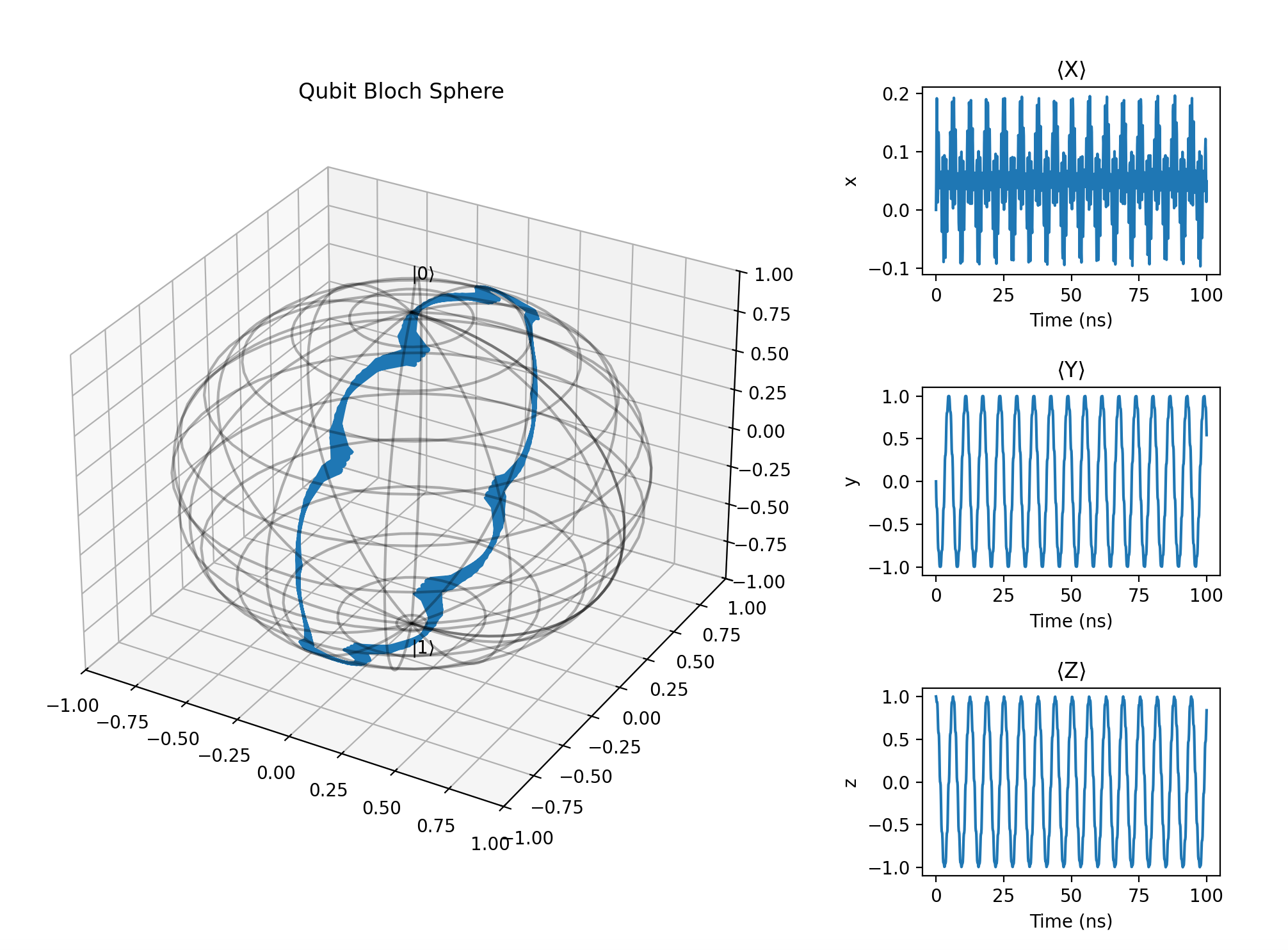
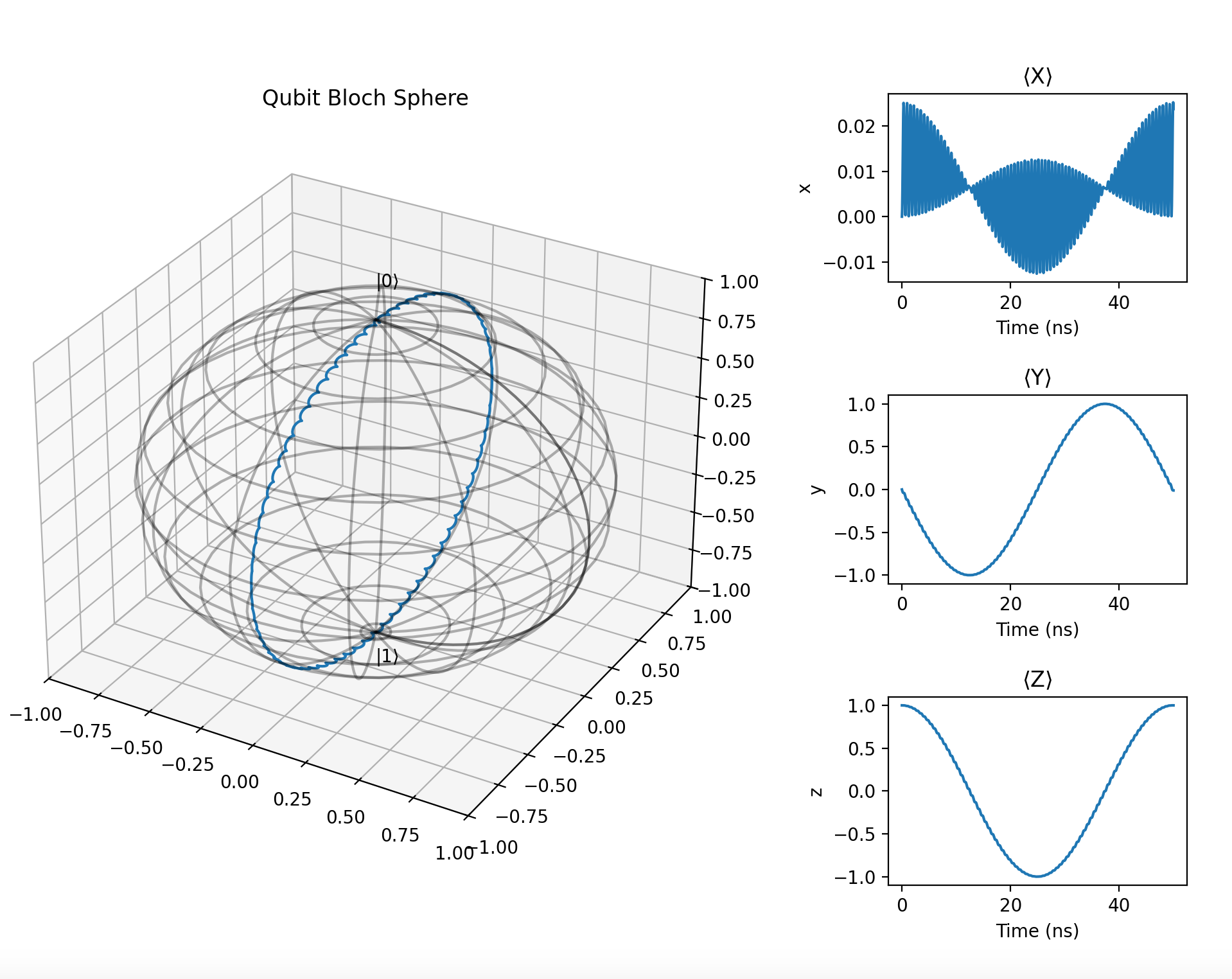
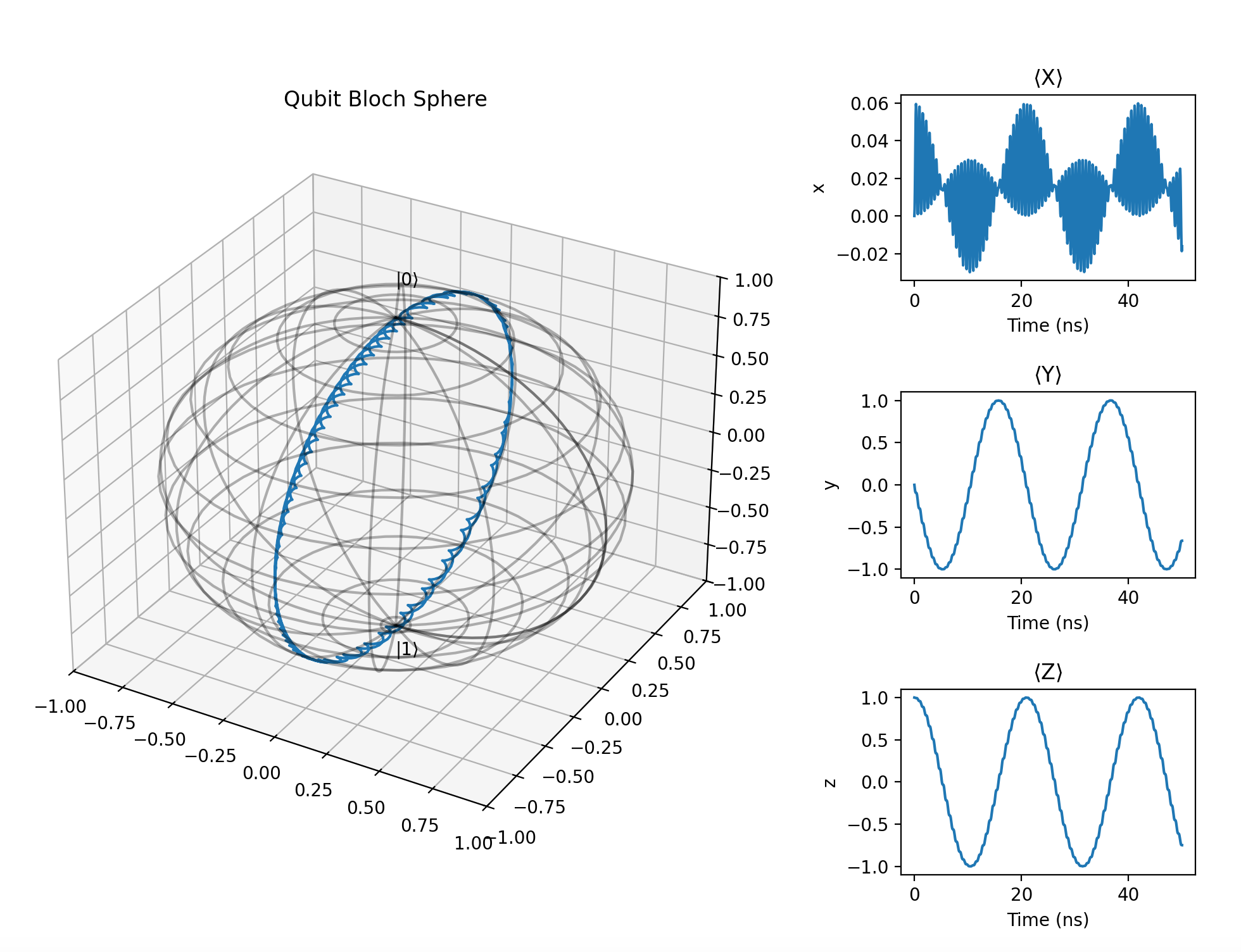
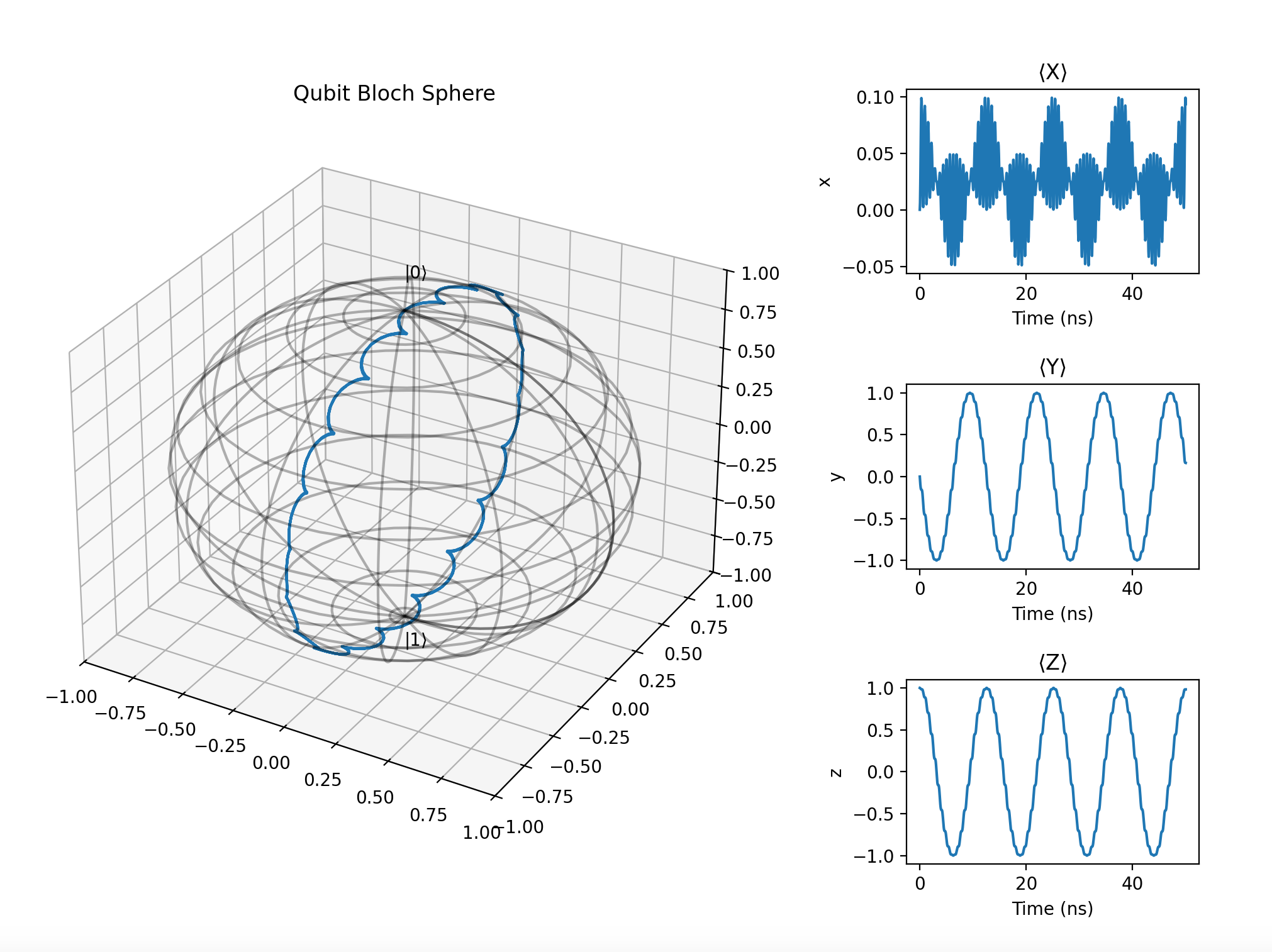
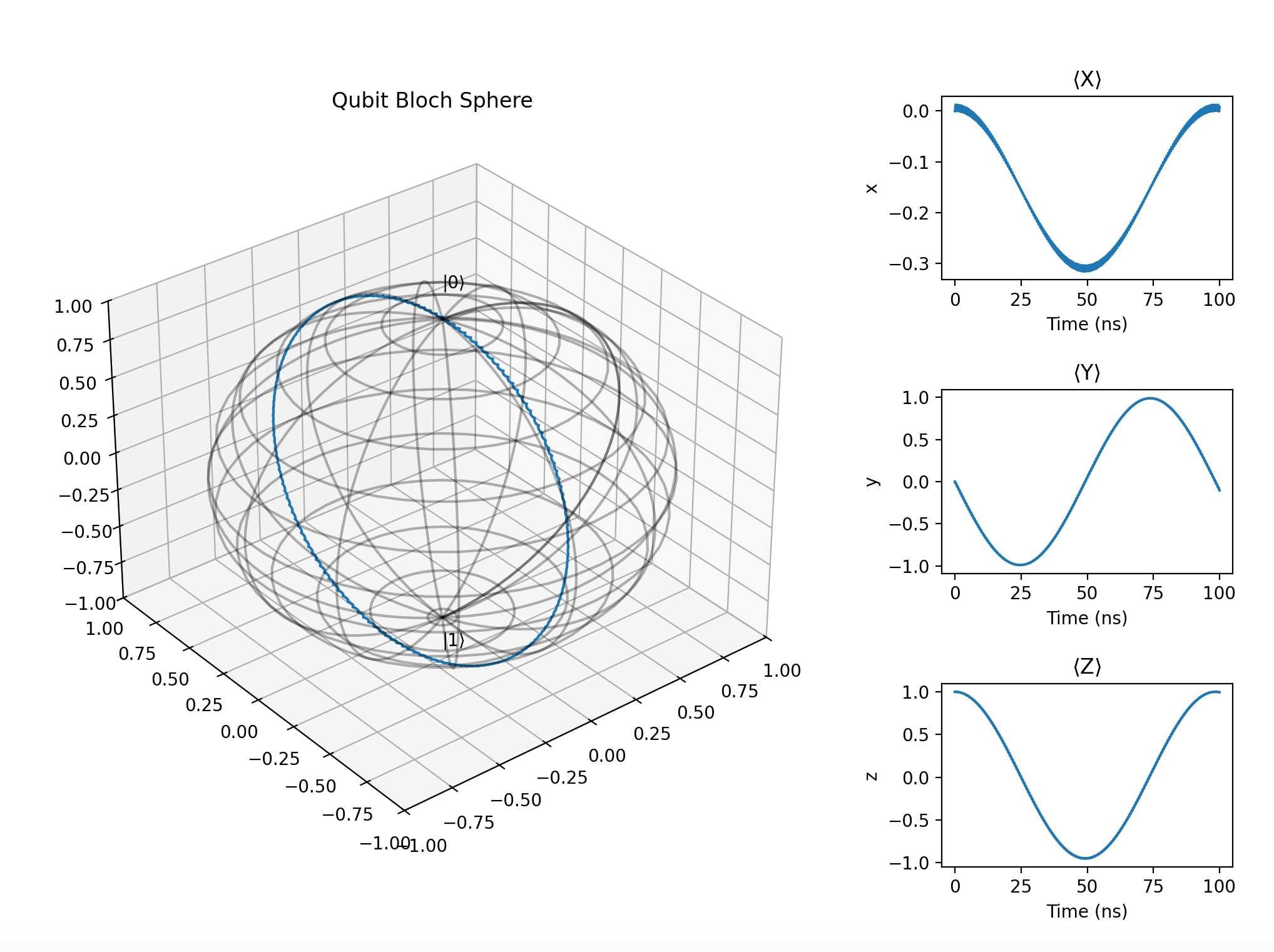
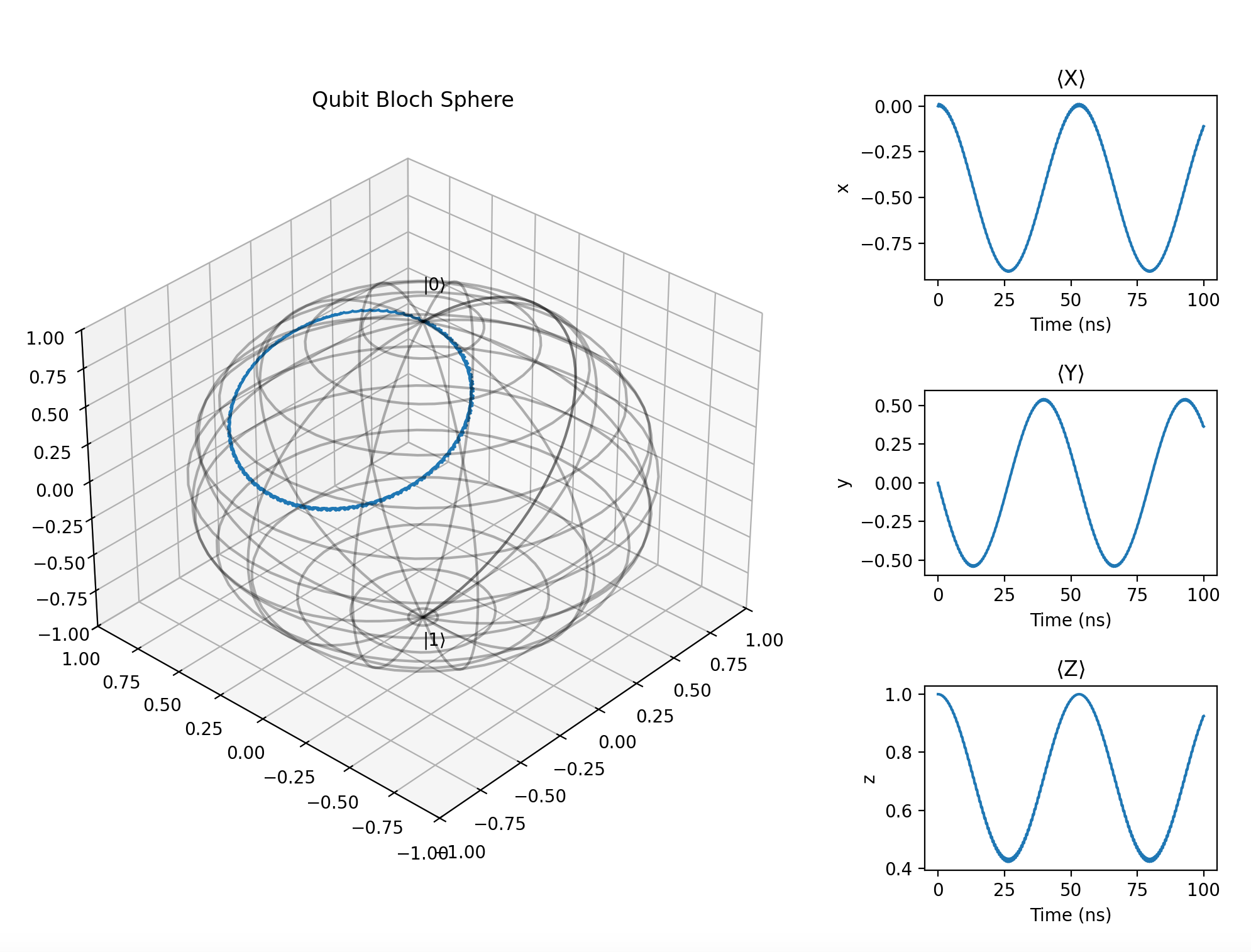
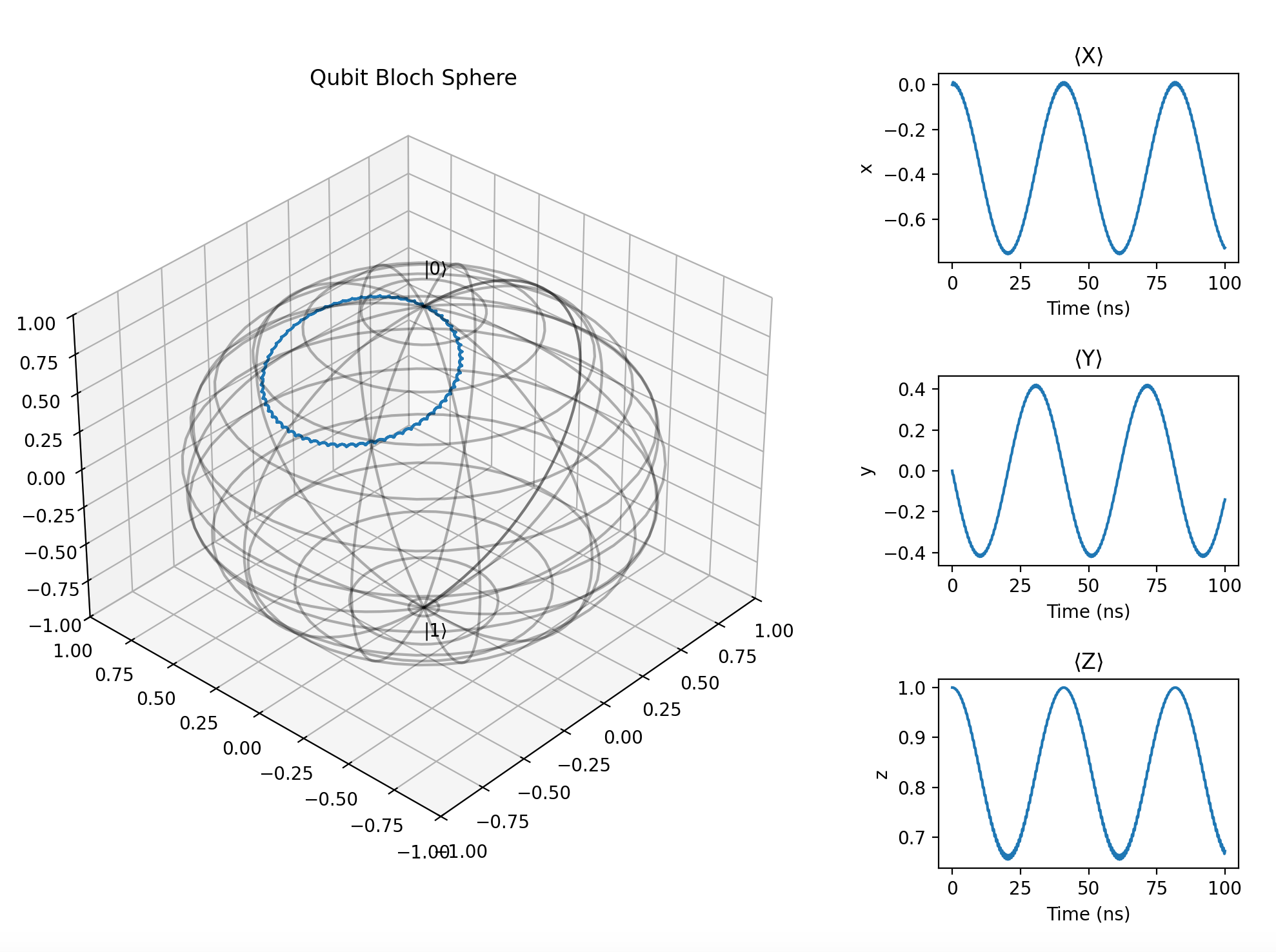
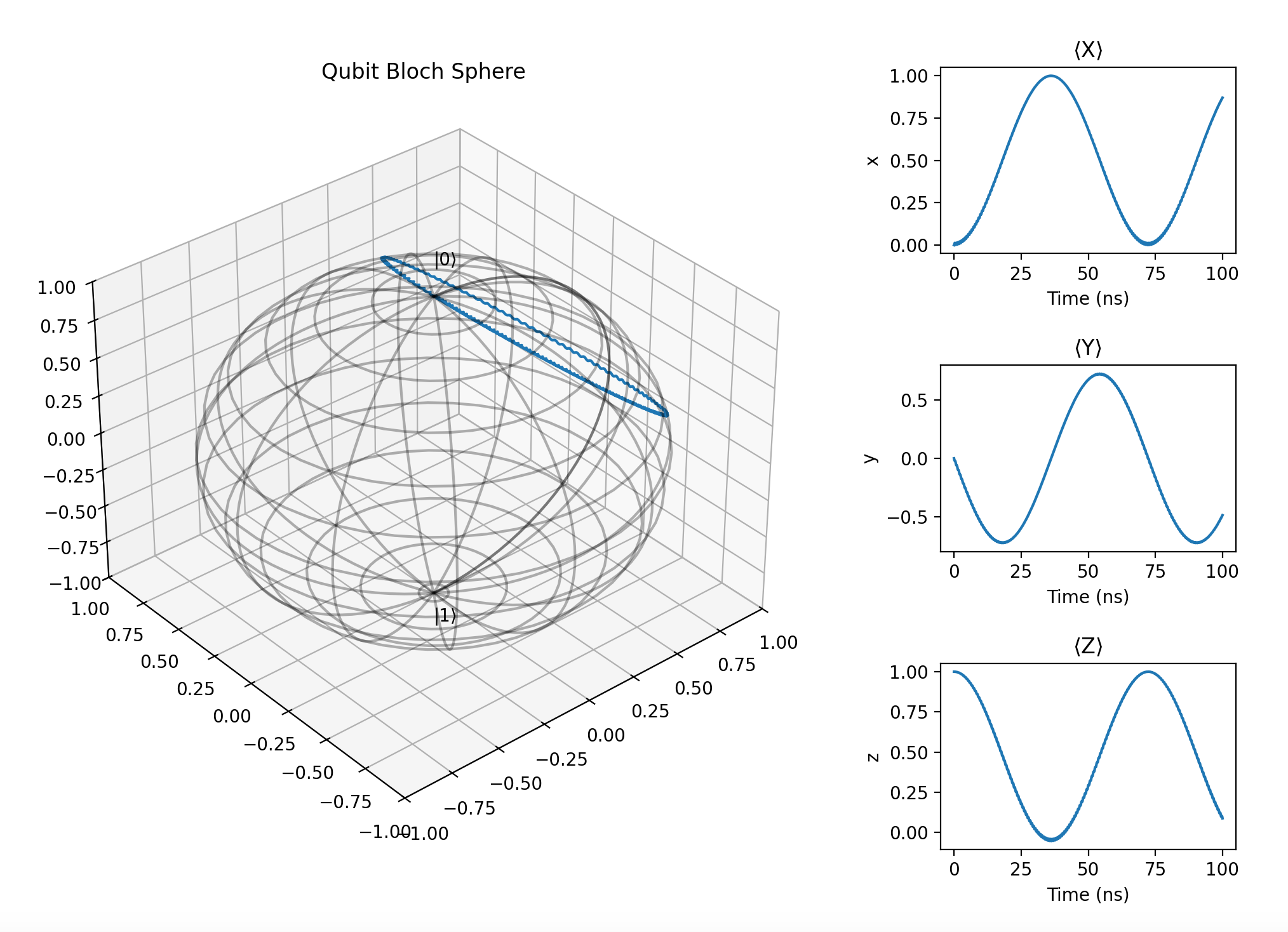
At ωd=ωq=5.0 GHz\omega_d = \omega_q=5.0\text{ GHz}, we vary AA relative to the timescale tt to assess the limits of the RWA. All frequencies are in GHz, all times in ns. The initial state is ψ0=0\ket{\psi_0}=\ket{0}.

The resonant RWA baseline:

image.png

Varying AA at timescale t=100 nst=100\text{ ns}:

A=0.063, A/ωq=0.0126A=0.063,\ A/\omega_q=0.0126

image.png

A=0.5, A/ωq=0.1A=0.5,\ A/\omega_q=0.1

image.png

A=1.0, A/ωq=0.2A=1.0,\ A/\omega_q=0.2

image.png

Varying AA at timescale t=50 nst=50\text{ ns}:

A=0.126, A/ωq=0.0252A=0.126,\ A/\omega_q=0.0252

image.png

A=0.3, A/ωq=0.06A=0.3,\ A/\omega_q=0.06

image.png

A=0.5, A/ωq=0.1A=0.5,\ A/\omega_q=0.1

image.png

From these plots and mathematical analysis, we draw two conclusions:

  1. To complete a full cycle, At2πA\cdot t\approx2\pi. This gives a period of t=2πAt=\frac{2\pi}{A}.
  2. For the RWA to be valid, AωqA\ll\omega_q. As a general rule, A/ωq0.05A/\omega_q \lesssim 0.05 yields a good approximation.

Off-Resonant Driving

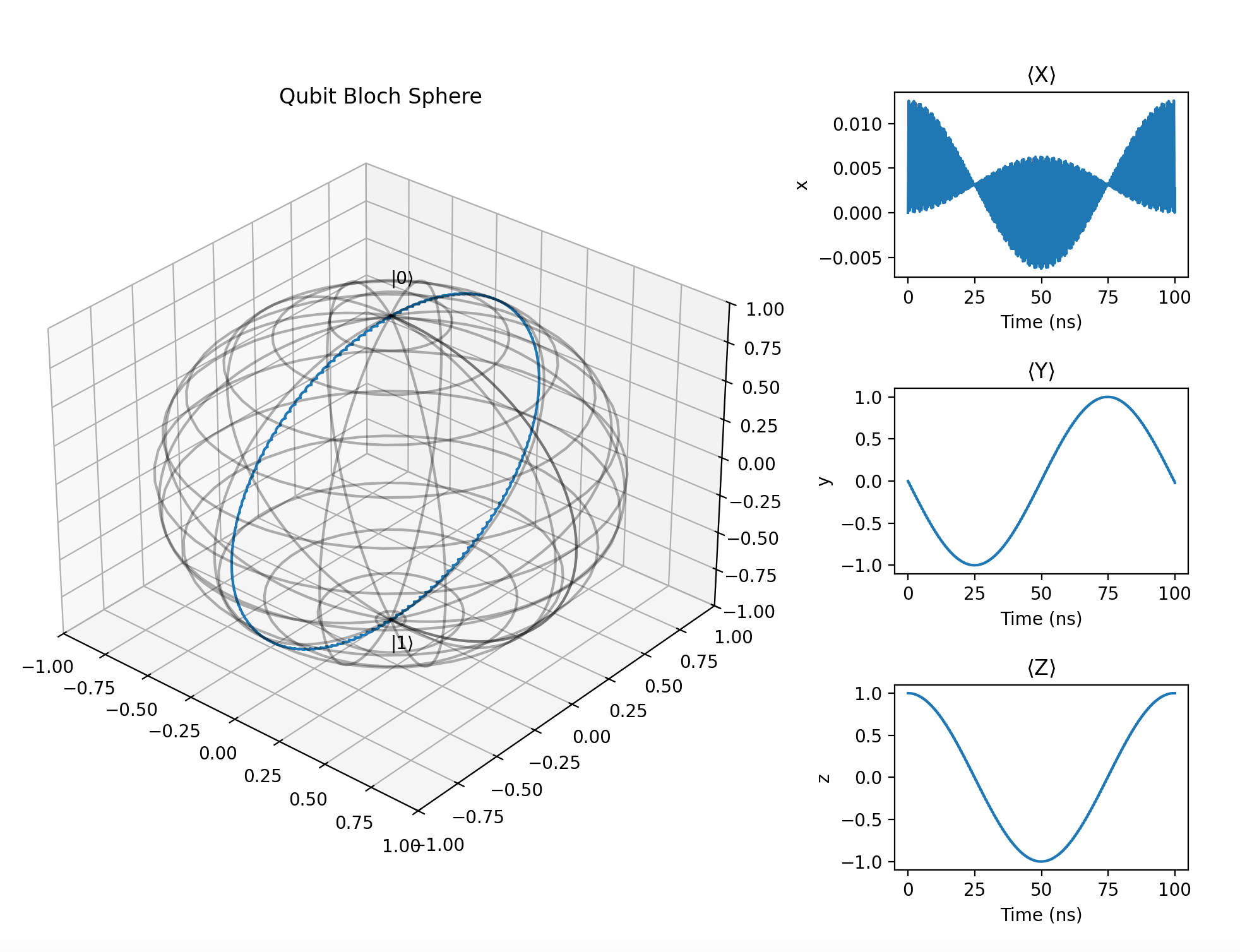
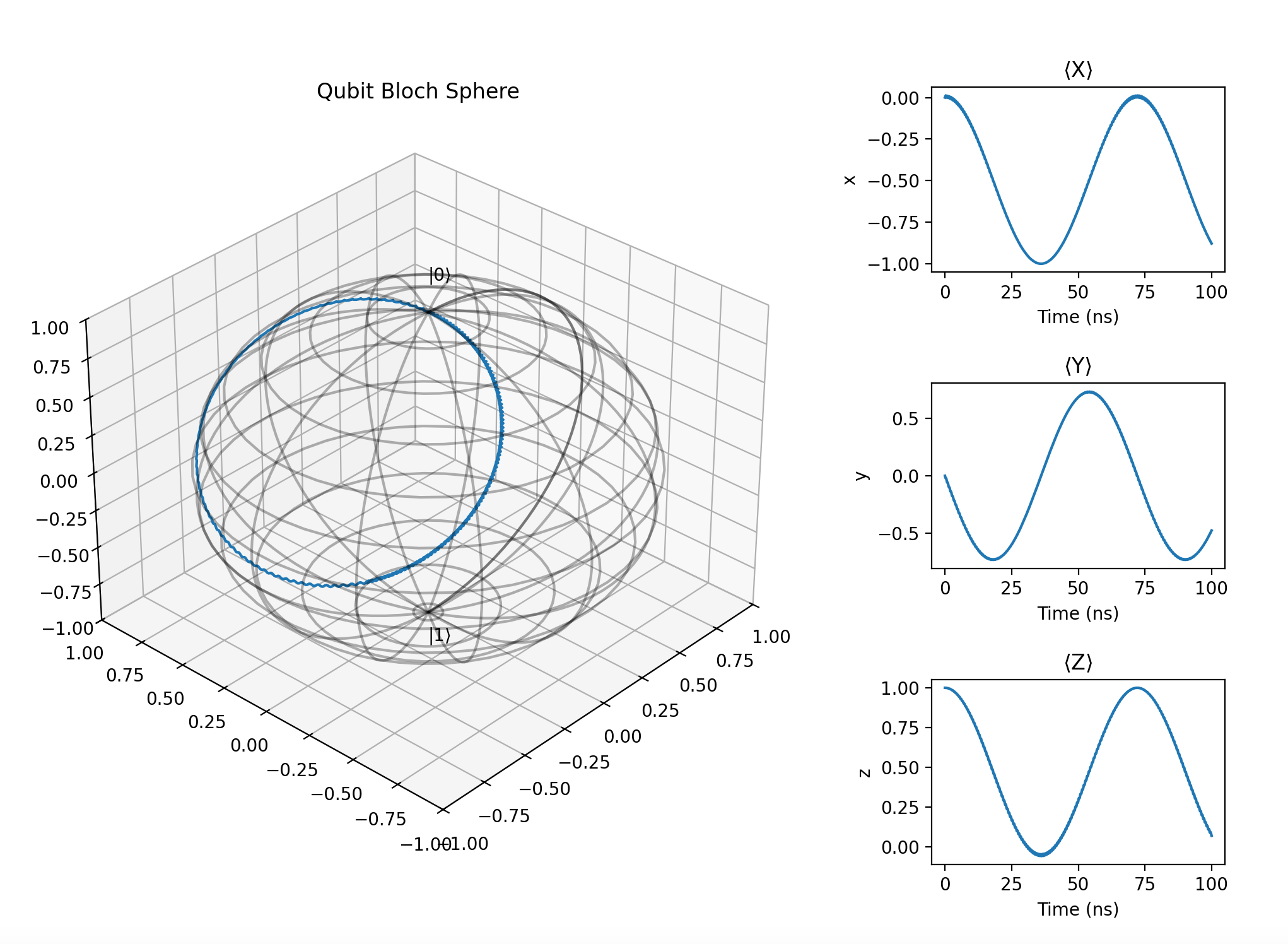
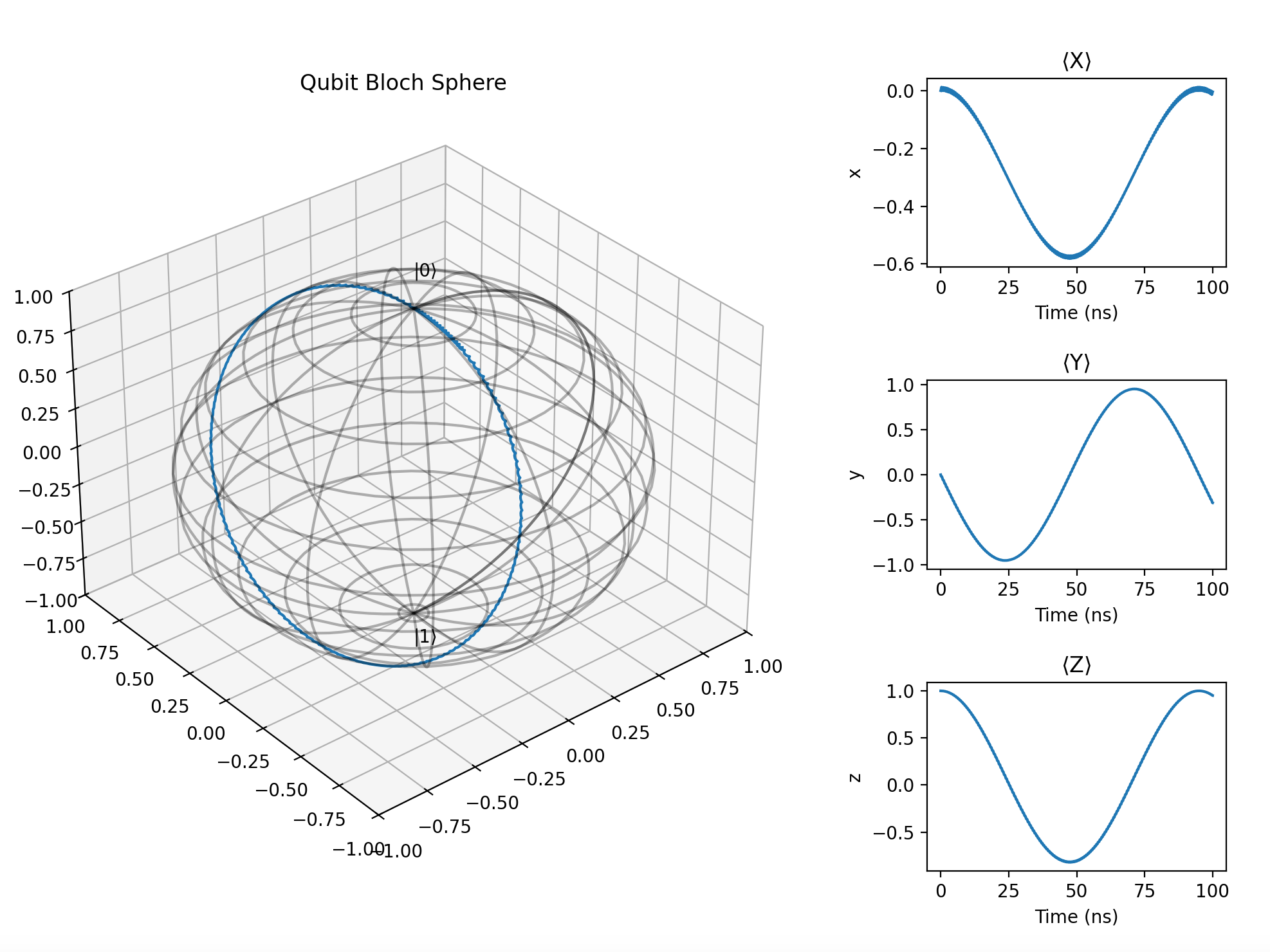
We now consider ωdωq\omega_d\neq\omega_q and display the effects of an off-resonant driving field. Using ψ0=0\ket{\psi_0}=\ket{0}, t=100 nst=100\text{ ns}, A=0.063A=0.063, and ωq=5.0 GHz\omega_q=5.0\text{ GHz}:

ωd=5.005\omega_d=5.005

image.png

ωd=5.01\omega_d=5.01

image.png

ωd=5.03\omega_d=5.03

image.png

ωd=5.05\omega_d=5.05

image.png

ωd=5.07\omega_d=5.07

image.png

ωd=4.97\omega_d=4.97

image.png

Off-resonant driving shrinks the rotation progressively toward the initial state 0\ket{0}. As the drive frequency moves farther from the qubit frequency, the z\langle z\rangle plot approaches 1.001.00 and the y\langle y\rangle plot approaches 0.000.00.